We have a lot of family that lives on the East coast. Not only on Mary Margaret’s side of the family tree, who we have been visiting since we arrived here the Washington DC area, but on my side also. In fact, we used to live in Delaware for 9 years starting way back in 1976. We moved there when I was accepted into U. of Delaware’s Ph.D. program in Marine Engineering. Mary Margaret also finished her Master’s program in Nursing at U. of Pennsylvania while we lived there and all three of our kids were born in Delaware.
As I write this, my brother, Don, and his wife, Debbie, are driving from Connecticut, where they have lived for years, to Blaine, Washington. Don has just retired and they have bought a new house in Blaine where they will be living. They have a beautiful 40-foot Grand Banks trawler which they keep in Bellingham and then use to sail around the San Juan Islands and up the Inland Passage to Alaska.
They have two daughters that still live on the East coast. The youngest, Sarah, lives with her husband, John, up in New Jersey while the eldest, Katie, lives in Maryland, not far from Washington DC.
My family’s history on the East coast even goes back to when my parents, shortly after I was born in 1950, moved to Fort Lee, New Jersey so my dad could attend Columbia University where he got his Masters Degree in Education. We lived there for three years, before moving to Michigan, where he received his Ph.D. at Michigan State University.
Thus, you can see we have a significant history on the East coast and that is why Mary Margaret and I wanted to drive all the way across the US to come here. Family means a lot to us and we longed to meet up with as many of our relatives that we could.
Today, we were treated with a get-together with our niece, Katie, who is my brother, Don’s, daughter. We last saw her in 2015. She is a remarkable woman, as she is making her way up the corporate ladder in the male dominated gaming profession. She is a manager at a Maryland casino, in charge of up to 80 dealers and pit bosses. She loves her job and the company she works for, which we find very exciting. We have long preached to our kids that whatever job they have, they need to chose one where they will be happy. One spends so much time at work that if it is not something one enjoys, it can have a profound impact on one’s immediate family and outlook on life.
Since it was a work “day” for Katie (her shift starts at 5 PM), we got together for lunch at a restaurant which was more convenient for her instead of coming to our bus. She shared with us that it was a restaurant that she would meet her dad at whenever he would come to Washington DC.
Along with managing part of a casino, she is also a part time professional gambler. She no longer does this as much as she once did (she used to live in Las Vegas before moving back to the East coast) but still enjoys competing at the gaming tables. This was something that I was curious to learn more about and I learned that when she gambles, she usually sells a subscription to raise money and then splits her winnings with the various subscription holders. Katie shared with us that she is fairly well known and does not have a hard time selling out her subscriptions since she has always turned a profit at this endeavor for her and her subscription holders. Wow! That is pretty darn amazing.
The time flew by and all too soon it was time say our good byes so Katie could return home and get ready for work. It was a special treat for us to see Katie again and we hope it will not be too long before we can see her again.
First, I wish to thank everybody who was kind and sent me special wishes on my birthday. I am so touched to have so many people to take the time and make the effort to reach out and wish me a happy birthday. That was really nice. I also wish to thank all of you who were so very generous and donated to the charity I sponsored for my birthday. It was Planned Parenthood, an organization that has done so much for the reproductive health of woman. I know some people oppose this organization because if its stand on abortion rights, but that is just one small part of its program. Whether one is for or against abortion rights, Planned Parenthood does so much more in helping women cope with reproductive issues. These include: birth control and long-acting reversible contraception; emergency contraception; clinical breast examinations; cervical cancer screening; pregnancy testing and pregnancy options counseling; testing and treatment for sexually transmitted infections; sex education; vasectomies; and LGBT services.
I set a goal of raising $200 and was so impressed that people donated $620 through this sponsorship. Now, for all of you who were so generous to donate, please be sure to claim that donation on your taxes. Even though I sponsored the charity, you get the tax benefit of your generosity! Whoo Hoo!
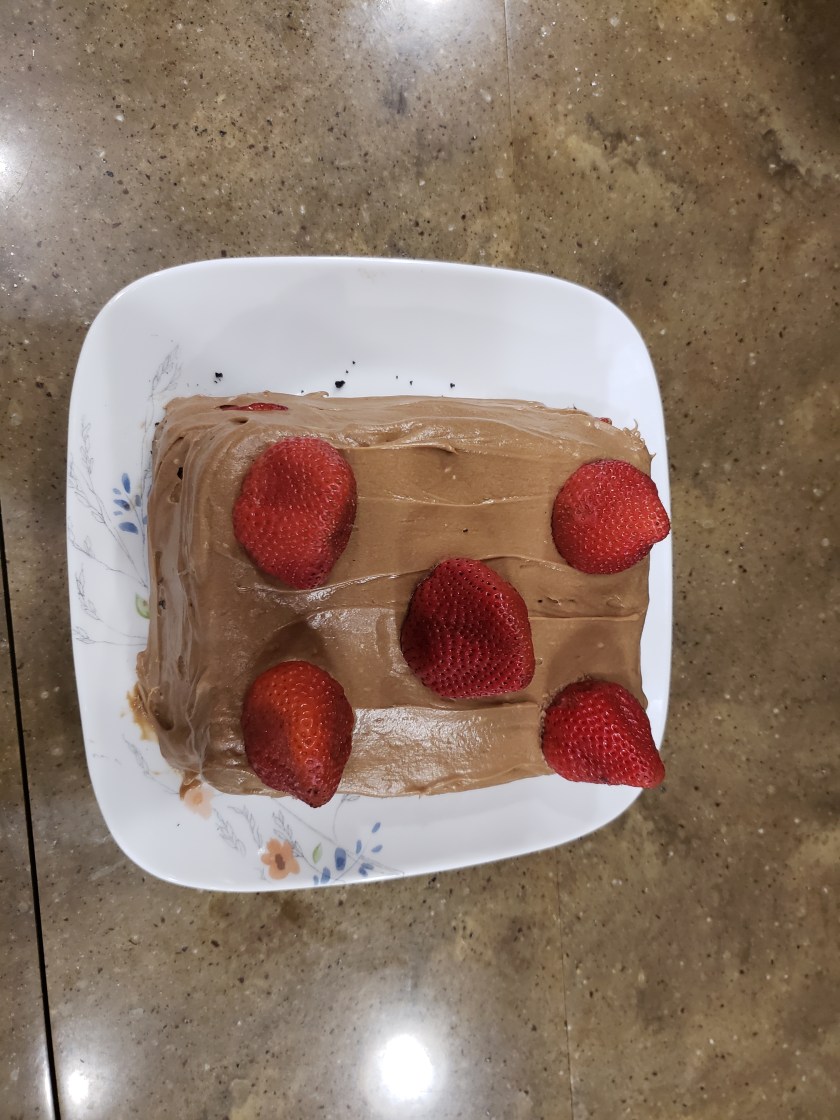
My loving wife and life mate, Mary Margaret, baked me a birthday cake for today and it was my favorite: chocolate cake with chocolate butter frosting, covered with plump, juicy strawberries and with sliced strawberries swimming in the chocolate frosting between the two layers. Oooooooh, it was soooo good! The cake was so large, I am looking forward to having some for breakfast tomorrow!
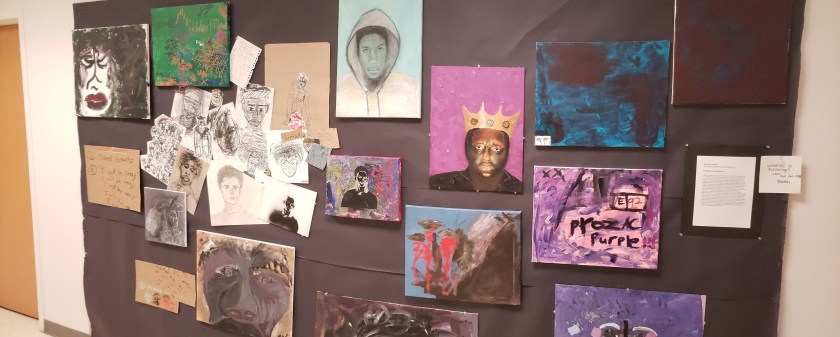
We also celebrated my birthday by attending our niece’s son’s high school art show and ceremony. Katharine’s son, Brendan, is graduating this year and the senior art students were recognized in a special ceremony and art show. It was a treat to attend and Mary Margaret and I discovered how very talented he is. His exhibit was a wall mural with various pieces of art displayed, all focused on the process of creating the art, not the individual pieces.
Brendan received another award during the ceremony as his dad, Morgan, arrived having just stepped off of a very long flight from Hong Kong. Morgan works for the World Bank and was attending a series of overseas meetings. However, he diverted his flight from Hong Kong to India so he could attend the art show and Brendan’s graduation this weekend.
We finished up the day by having a wonderful dinner with Mary Margaret’s sister, Lonie and her husband, Rich, at a French Belgium restaurant called Et Viola. I spoiled myself with French onion soup, foie gras and a huge pot of steam mussels swimming in lobster bisque. Yum!
Tomorrow, we get to meet up with another one of our niece’s, Katie. She is my brother Don’s daughter. We last saw Katie at her sister, Sarah’s, wedding back in 2015. We are looking forward to seeing her again.
As a closing note, I wish to share that Michael’s brother (Michael is our daughter, Christina’s, husband) Nate and his wife Katie, had a baby girl today. Whoo Hoo! Little Mecaslin Rose…6lbs 5ozs, 20″ long, chose this special day to join the family. Now that is a very special birthday present!
These last many years Mary Margaret and I have not had many opportunities to spend Memorial Day with family. Since we moved onto our sailboat, over 10 years ago, we mostly have been on our boat or, in 2015 when we toured the west coast of the North America while back in the US for our son’s wedding, we were up in Vancouver, BC, Canada on this day. Now, that we have sold Leu Cat and are touring the US in LeuC, this is our first time in so many years being able to celebrate Memorial Day with a BBQ with family. Whoo Hoo!
Mary Margaret’s sister, Lonie, and her husband, Rich, invited us to spend today with them and their kids who live in the Washington DC area. Lonie and Rich belong to Kenwood Country Club and they reserved a table for all of us to enjoy the Memorial Day BBQ that Kenwood was putting on.
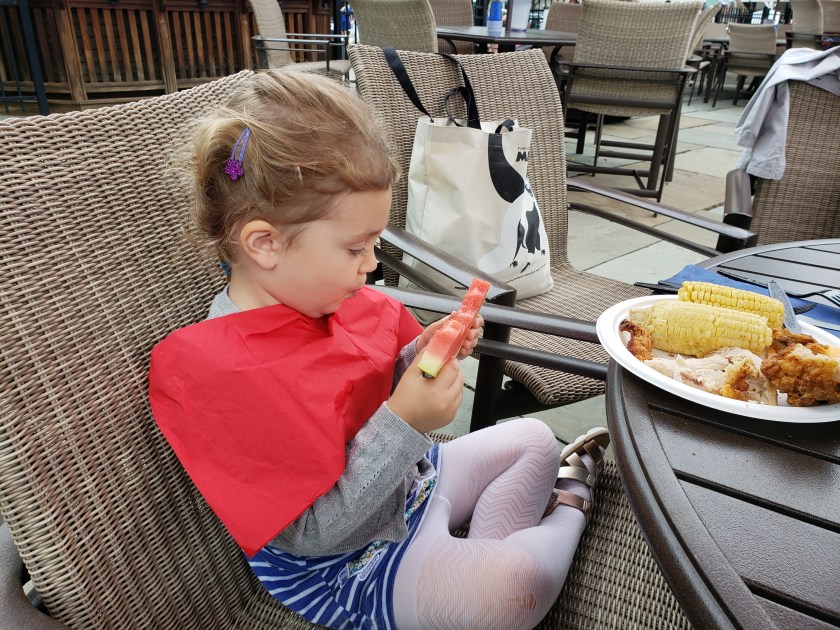
It was such a treat for us to spend this time with them. There were six of us adults (Lonie, Rich, Katherine, Sarah, Mary Margaret and I) and one little one, Sarah’s 3-year-old daughter, Finn. Finn really got into the spirit of things as she by passed the fried chicken and corn on the cobb and dove immediately into the two very large pieces of watermelon. Now that is a kid after my own heart! I, too, love watermelon and seldom can get enough of it. In the end, Finn’s mom, Sarah, was able to sneak a bite or two of chicken down her throat but it was a struggle. Hmmmm…. Watermelon or chicken, watermelon or chicken? It was not hard to figure out which one was devoured.
Time just seemed to fly by as Mary Margaret and we soaked up the love and good times of being with family. Before we knew it, it was well after 5 o’clock and the entire afternoon had flown by.
Tomorrow, we will be driving back into Washington DC to go to Katherine’s eldest son, Branden’s, high school. They are having an art show in which Branden has some art on display. Afterward, we will be taking everyone out for dinner. Another fun time with family!
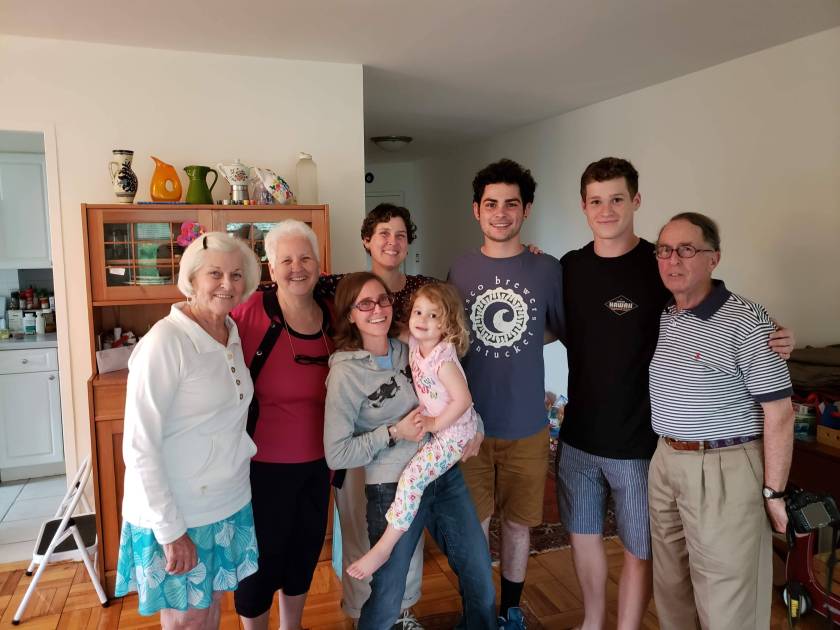
Today, Mary Margaret and I drove 45 minutes into Washington DC to spend the evening with Sarah and have a family get together. Once we arrived, we were soon joined by Katherine and her two boys, Branden and Jamie. Branden will be graduating from high school next week and has just returned from working on a goat farm for the last two weeks. He brought with him a couple of containers of goat cheese that he made and a large jar of sauerkraut that he made. The sauerkraut was pickled using the whey from the cheesemaking. The cheeses and the sauerkraut were delicious!
Branden’s goodies melded well with the spread that Sarah had laid out which included two types of salami, a mix of green and Greek olives, cheese spread, humus, crackers and chips, all complimented with your drink of choice. Katherine brought home-made gazpacho that was to die for and Lonie brought a large wedge of cheese, whose name I have forgotten. It was all very, very good!
It was so good to see everyone again. I had a chance to talk with Branden and Jamie and was excited to do so. Jamie will be going out to Palo Alto, California in a couple of weeks to tour Stanford University, one of the schools he is looking into attending. He is just finishing up his Junior year in high school and is well into the evaluation process, searching out where he wants to go to continue his education. He will be joined with the rest of his family as they will all be driving from the San Francisco Bay area up to Sun Valley, Idaho for a vacation. While in the San Francisco Bay area, they will have breakfast with our daughter Heather and our son, David Paul, and their respective families. Whoo Hoo!
Tomorrow, we have been invited by Lonie and Rich to a Memorial Day BBQ at their country club, Kenwood. We will with joined by Katherine, Sarah and Finn. More quality time with family!
A couple of days ago we bundled up ol’ LeuC and drove about 3.5 hours, going from our campground across the James River from Jamestown, Virginia up to our new campground in Reston, Virginia. It was an easy drive with most of it being freeway driving. It was only about 170 miles and the reason it took so long was that we ran into a 30-minute traffic slow down as we approached the Washington DC area.
Our campground for the next two weeks is the Lake Fairfax Recreational Area located in Reston, Va. It is not the nicest campground we have stayed at but it is only about 45 minutes from downtown Washington, DC and even less than that to Bethesda, Maryland, where Mary Margaret’s oldest sister, Lonie, lives. Mary Margaret also has another sister, Gaby and two nieces (Lonie’s children): Katherine and Sarah, who live in the area. We hope to visit with all of them while we are in this area.
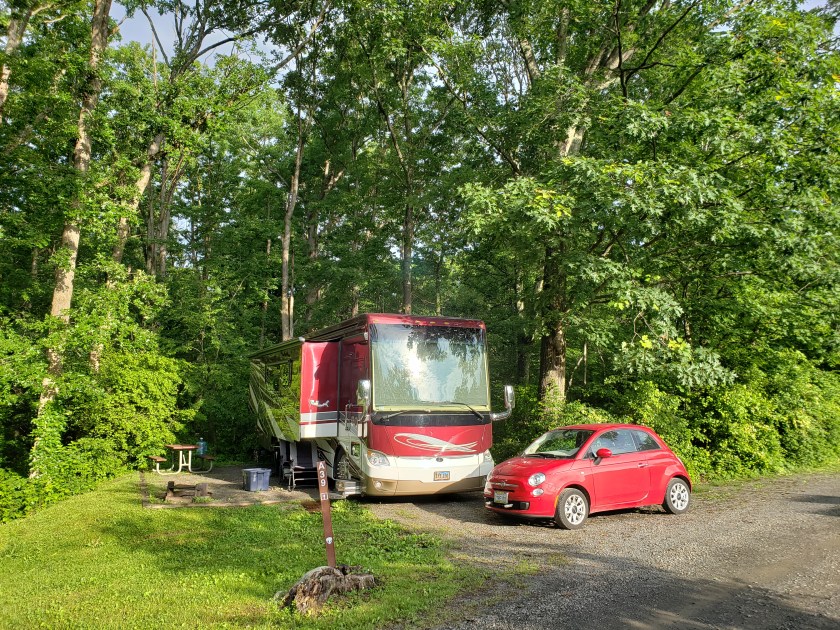
Our campground reminds us of camping in Europe. Most of those campgrounds really pack ‘em in as people pitch their tents right next to each other. There is very little privacy. The central part of our campground is just like that with campers and their tents or RVs are packed in close to each other. Ugh! We are a bit more fortunate than most as we were able to reserve a site that backs into the forest that surrounds the park. Thus, we have a bit more privacy… as long as you look in the proper direction. The pictures that I will post to this blog shows you what I mean.
Another disappointment for us is that while we have 50 Amp power at our site, there is no direct water hookup. There is just a one centrally located water spigot for the entire campground. Normally, this would not be a big deal but last week our water pump that pumps the water from our 100-gallon fresh water tank throughout LeuC failed. Whenever we do not have a direct water hookup option, we have to rely on our water tank and water pump. Without a working water pump, we have no running water.
Last week, while camping near Jamestown, this was not a big deal because we just hooked up LeuC to the water spigot at our campsite and this provided water and water pressure throughout LeuC. However, in our new campground without a water spigot to hookup to, we were bone dry.
Fortunately, when our water pump failed, I had ordered a replacement pump and it was waiting for us when we drove over to Lonie’s house. The first thing I did this morning was switch out the pumps so we now had water inside LeuC again. Yea!
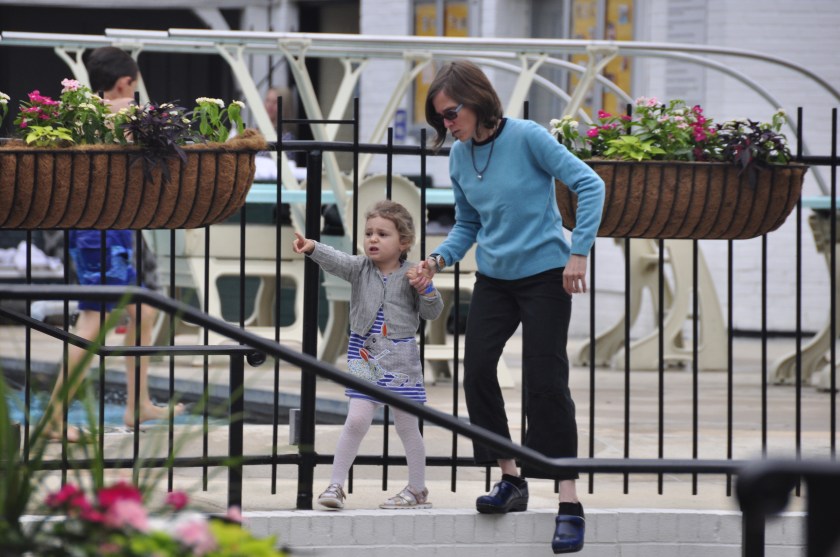
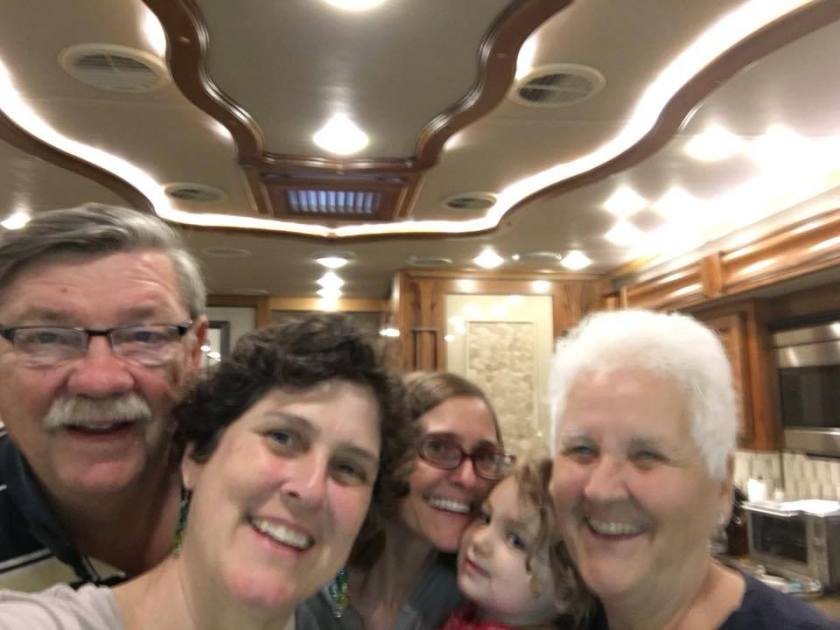
Soon after the pump was installed, Mary Margaret’s two nieces, Katherine and Sarah came for a visit. Sarah also brought her lovely 3-year-old daughter, Finn. We had a wonderful reunion, catching up on things that have happened since we last saw them.
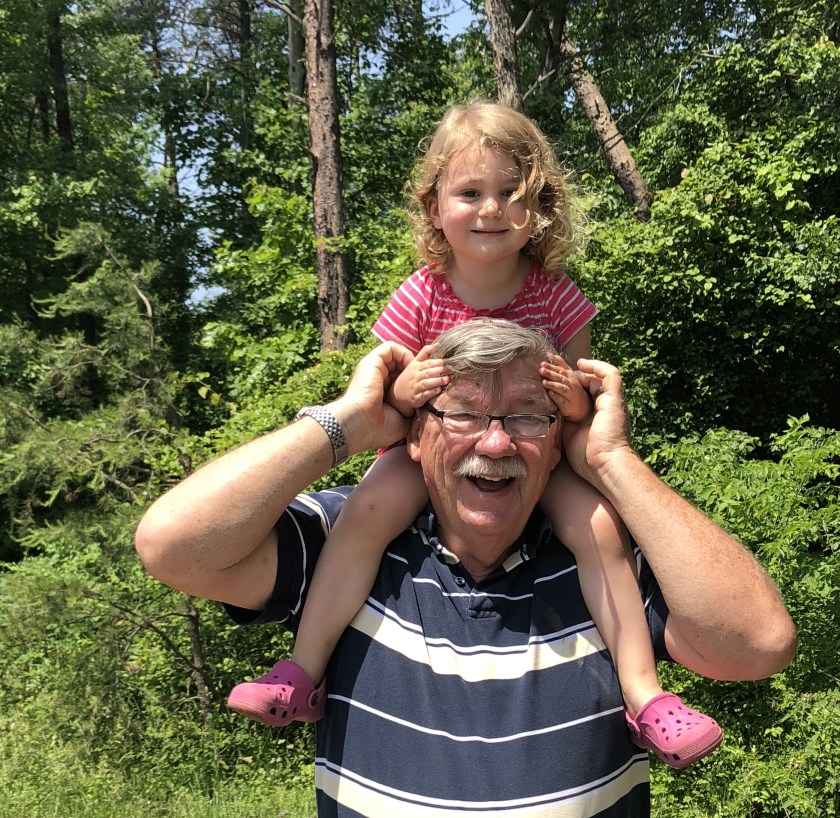
We also went for a little hike through the woods, which we all enjoyed. Along the way Finn got a horsey ride.
Tomorrow we run over to Sarah’s apartment in Washington DC and will be joined by Loni, Rich, Katherine and our two boys, Branden and Jamie. Her husband, Morgan, is working overseas so we will miss him.
Originally, we had planned on spending a day at Colonial Williamsburg. It is the historical district of Williamsburg where they have preserved or restored many original colonial era buildings and homes. However, we enjoyed these last couple of days exploring Jamestown and Yorktown so much that we decided to skip Colonial Williamsburg and return to see parts of the museums at Jamestown and Yorktown that we missed. Our logic was that we had been to Colonial Williamsburg before when we lived in Delaware way back during the late 1970’s and early 1980’s and it most likely has not changed that much since then. With this being our last day before we move on to spend a couple of weeks in the Washington DC area tomorrow, we wanted to fully explore Jamestown and Yorktown since we enjoyed what we did see so much. Thus, this morning we hopped into our cute little Fiat and put-putted down the road, headed off to the ferry to cross the James River one more time.
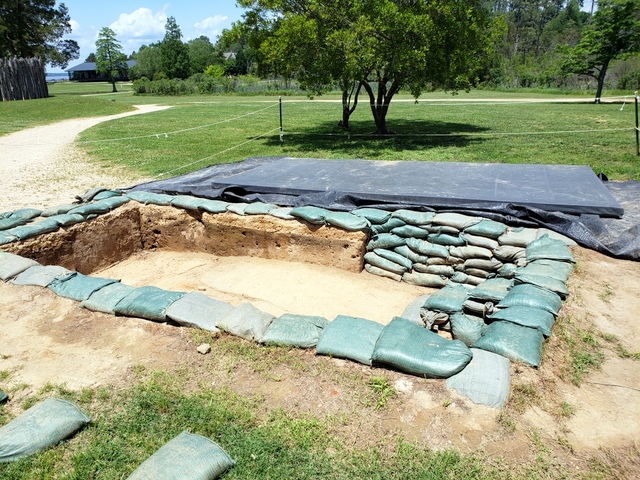
We first stopped at the Jamestown Museum and finished wandering through their galley of time, taking the time to more carefully read and enjoy those exhibits we had missed. After lunch in their cafeteria, we then drove over to the Jamestown National Park, where the actual site of Jamestown is located. While it is a national park, it is also an active archeological dig site and when we were there, we watch a few people carefully doing a dig. Despite what we were told at the Museum, the National Park Service has recreated parts of the original site including the wooden walls that surrounded the original settlement.
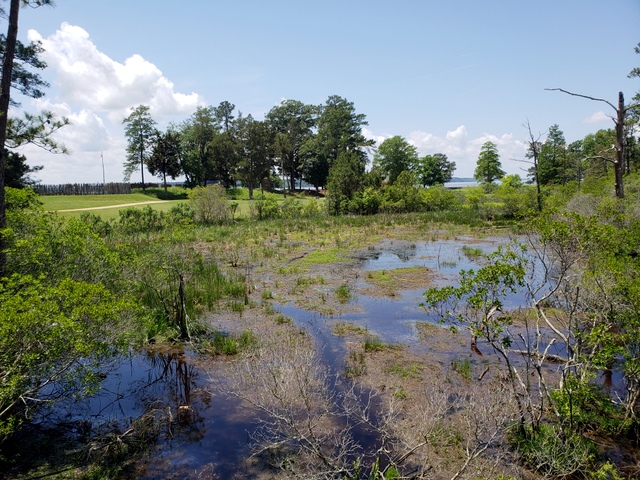
The original settlement was situated on a piece of ground that was between the James River and a swamp. Not the best place to live and the swamp and brackish water of the James is what led to the deaths of so many of the settlers. You can see the stockade in the background toward the left.
This is what the stockade looked like in 1607. It took them 19 days to build and you can see the poles and pegs that connected the individual logs together. Two years later, they rebuilt the stockade using split wood. You can see what that stockade looked like in the pictures I posted when we first went to the Jamestown Settlement Museum a few days ago.
Here are some of the information signs that I captured.
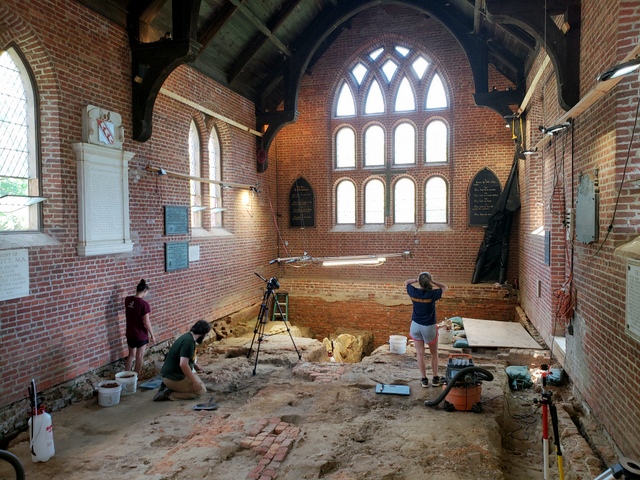
Here is the church that was built in 1906. However, it was built over the foundation of another church, which was built in 1617, They are in the process of doing an archaeological dig inside this church to uncover artifacts of that earlier period.
Here another area that is undergoing ab excavation.
A mockup of what the original settlement looked like back in 1607.
The crosses mark locations where some of the settlers were buried. They were buried inside the stockade for fear that the Native Americans would desecrate the graves if dug outside the stockade.
We next drove back to Yorktown to revisit the museum there. As we entered, we discovered we were just in time to take in another lecture, this one being on Alexander Hamilton. A few years ago, I read Ron Chernow’s biography on Hamilton and really enjoyed it. Thus, we both were anxious to hear the lecture.
The lecture was wonderful, albeit short, only about 35 minutes. It refreshed my memory on some of the details of Hamilton’s life that I had forgotten. He was a most remarkable person and played such an important role in the founding of our country. This included being the principle interpreter between Washington and General Rochambeau, the French commander of French Troops in America during the Revolutionary War. He also wrote 51 of the 85 essays that composed what become known as The Federalist Papers. These were written with John Jay and John Madison to promote the ratification of the Constitution. Hamilton is probably best known as the one who set up the First National Bank of the United States and created our country’s currency and help extinguished the huge debts that each of the 13 colonies had as a result of the long war. He did so much more but a discussion on that may, someday, be part of another blog.
After the lecture, we then went into the museum’s galleries and enjoyed exploring them. The galleries are set up along the critical time periods of the Revolutionary War and contain a variety of multi-media, extractive exhibits that are wonderful. There are also a number of movies that you can sit in on, including one where the seats shake with each cannon that is fired and where the wind blows on you as the sea battle between the French and the British takes place near the mouth of the Chesapeake Bay. It was pretty cool!
Here are some of the photos I took of a couple of the multimedia exhibits.
By now, it was late in the afternoon but we still had one more stop to make. Thus, we hustled back to the ferry, crossed the James River one last time and arrived at the Edward’s Virginia Smoked Ham store in Surry, Virginia. This is the home store where Edward’s was founded. It is a famous chain of outlets that distributes various types of Virginia Smoked hams which are made in Surry.
We left armed with a bundle of hams and a pocket that was cleaned out of money. Nevertheless, we had big smiles on our faces knowing that these rich and succulent hams were now in our possession.
This morning we headed off for Yorktown. It too is situated on the same peninsula as Jamestown but unlike Jamestown, it is located on the York River side of the peninsula and near where it empties into the Chesapeake Bay. Jamestown is located about 30 or so miles up the James River. While Jamestown was founded well up James River to be well hidden from the Spanish entering Chesapeake Bay, Yorktown is more conveniently located for ships entering the Chesapeake Bay from the Atlantic Ocean. It was this easy port access for landing troops and supplies that lead the British to select it as a base of operations.
The National Park Service maintains the battlefield and offers a fairly simple museum on its grounds. When we arrived, we first explored the museum and then decided to take the driving tour of the battlefield. The Park Service has road makers along the way, noting various stops where historically significant activities took place. Mary Margaret read the history of each stop after which I ran out and took pictures.
We then drove into the village of Yorktown which had a distinct touristy feel for us. While somewhat quaint, it really was not our cup of tea. After a nice lunch, we drove over to the American Revolutionary War Museum. This is part of the same historical foundation that runs the Jamestown Settlement Museum that we loved so much yesterday. Following the same format, this museum had a wonderful series of galleries to wander through along with outside reconstructions of an American revolutionary army camp and a small farming village.
Our timing was wonderful because as we started to explore the museum, a historian met us and invited us to attend his lecture on the battle of Yorktown that he was about to start. It was a real treat to attend and we learned a lot of background information that we might have otherwise missed.
Once the lecture was over, Mary Margaret and I decided to split up since our time was now short and there was so much to see. I went outside to explore the reconstructions while she explored the galleries. We met back up at the theater where we both attended a film about the history of the revolution but it paled in comparison to the lecture that we had earlier attended.
I will offer a brief write up of what we learned during the lecture and, in the process, sprinkle some of the photos I took today so you can see what I am trying to describe.
Yorktown was made famous by the defeat of General Cornwallis and his British troops by General Washington and his combined army of American and French troops back in 1781 which was the last major battle during the Revolutionary War.
By the summer of 1781, the United States had been at war with England for over six years. The first shots had been fired in April 1775 on the village green in Lexington and at North Bridge in Concord, Massachusetts. Merely sustaining the army had been a major accomplishment for the Americans, who did not have much money, food or clothing. The winters of 1777-78 at Valley Forge and 1779-80 at Morristown were particularly devastating, with many soldiers freezing and starving to death, and some giving up and returning home.
In the summer of 1780, the Americans received a major boost to their cause when 5,500 French troops, commanded by Comte de Rochambeau, arrived at Newport, Rhode Island. France had been sending supplies to the United States all along, but after France and England declared war against each other in 1778, French King Louis XVI sent troops and naval assistance to the United States to engage the enemy.
When Rochambeau’s forces arrived, the British were operating on two fronts. General Clinton, commander of British forces in North America, was occupying New York City after a largely unsuccessful attempt to control the northern and middle colonies. General Lord Cornwallis was leading through the southern colonies an army that had already captured Savannah and Charleston. The main American army under Washington was stationed along the Hudson River above New York City.
In the spring of 1781, Washington traveled to Rhode Island to meet with Comte de Rochambeau and plan an attack on Clinton. A French fleet was expected to arrive in New York later that summer, and Washington wanted to coordinate the attack with the fleet’s arrival. As planned, Rochambeau’s army marched in July and joined with Washington’s troops outside New York City, only to learn that the French fleet was sailing to the lower Chesapeake Bay.
Washington changed his strategy to make Clinton think he was planning to attack him, while instead sneaking away to the south to trap Cornwallis. In order to fool Clinton, Washington had his men build big army camps and huge brick bread ovens visible from New York to give the appearance of preparations for a stay. Washington also prepared false papers under his signature discussing plans for an attack on Clinton, and let these papers fall into British hands. Leaving a small force behind, Washington and Rochambeau set out for Yorktown in mid-August. By early September they were parading before the Continental Congress in Philadelphia, and they arrived in Williamsburg, 13 miles west of Yorktown, in mid-September.
Cornwallis was in Yorktown because he had been ordered by Clinton during the summer to provide a protected harbor for the British fleet in the lower Chesapeake Bay. Cornwallis chose Yorktown because of its deep-water harbor on the York River. His army spent the latter part of the summer fortifying Yorktown and Gloucester Point across the York River.
The French fleet, as part of the overall plan, entered the lower Chesapeake Bay in the end of August and disembarked 3,000 French troops to wait for Washington and Rochambeau in Williamsburg. On September 5, they encountered the British fleet in a naval engagement known as the Battle of the Capes. The British suffered damage to their ships and returned to New York, while the French, commanded by Admiral de Grasse, remained in the lower Chesapeake and established a blockade.
By the end of September, approximately 17,600 American and French soldiers were gathered in Williamsburg, while 8,300 British soldiers were occupying Yorktown.
The British forces included a small number of German auxiliary troops hired to help fight the war. Cornwallis recognized the odds were in the allies’ favor, and he sent Clinton a note asking for help. Clinton responded that a British fleet with 5,000 men would sail for Yorktown from New York on October 5.
Cornwallis had his men construct a main line of defense around Yorktown that consisted of ten small earthen walled forts (called redoubts), batteries with artillery and connecting trenches. The Americans and French marched from Williamsburg to Yorktown on September 28 and began digging a trench 800 yards from the British defense line to begin a siege. By October 9, the allies’ trench was finished and their artillery had been moved up. Firing at the British continuously, they had virtually knocked the British guns out of action by October 11. Cornwallis had the additional misfortune to learn at that time that Clinton’s departure from New York had been delayed.
During the night of October 11, the allies began a second trench 400 yards from the British. The next days were spent bringing up artillery and strengthening the new line. The new line could not be completed, however, without capturing British redoubts 9 and 10. On the night of October 14, 400 French stormed redoubt 9 and 400 Americans stormed redoubt 10, capturing them in less than 30 minutes. Nine Americans and 15 French died in this brief and heroic action.
On October 16, the British tried two desperation moves. Early that morning they attacked the allied center, attempted to silence a French Battery, but the French cannons were firing again in less than six hours. Late that night they tried to evacuate Yorktown by crossing the York River in small boats to Gloucester Point. However, a violent storm hit the area at midnight, scattering the boats and forcing an abandonment of the escape.
Realizing the situation was hopeless, Cornwallis sent forth a British drummer on October 17, followed by a British officer with a white flag and note indicating a request for a cease fire. A number of notes passed between Cornwallis and Washington that day as they set the framework for the surrender. The next day, October 18, four officers–one American, one French and two British–met at the Moore House, one mile outside Yorktown, to settle surrender terms.
On October 19, most of Cornwallis’ army marched out of Yorktown between two lines of allied soldiers–Americans on one side and French on the other–that stretched for more than one mile. The British marched to a field where they laid down their arms and returned to Yorktown. They did not know that on that very day, Clinton sailed for Yorktown from New York with 5,000 troops.
News of the British defeat at Yorktown spread quickly. Celebrations took place throughout the United States. London was shocked. The British prisoners were marched to prison camps in Winchester, Virginia and Frederick, Maryland. The American army returned to the Hudson River, while the French army remained in Yorktown and Williamsburg for the winter. Clinton and Cornwallis eventually returned to England where they engaged in a long and bitter public controversy over who was to blame for the British defeat at Yorktown.
Though the British still had 26,000 troops in North America after Yorktown, the political resolve in London to win the war was nothing like it had been before Yorktown. The war had been lengthy and costly. Replacing Cornwallis’ captured army was a questionable proposition, particularly because the British also were engaged in military struggles in India, Gibraltar, the West Indies and Ireland. Thus, the British Parliament in March 1782 passes a resolution saying the British should not continue the war against the United States. Later that year, commissioners of the United States and Great Britain signed provisional articles of peace. In September 1783, the final treaty was signed which ended the war and acknowledged American independence.
Here are a few of the photos of the colonial farmstead that was reconstructed at the museum.
Today, we took the ferry across the James River and explored Jamestown. Well, we actually never made it to the Jamestown National Park, where the original Jamestown was established. We hope to stop there tomorrow on our way to Yorktown. Where Jamestown original stood is an archeological site and we have been told there is nothing to see above the ground since none of the structures no long exist. Instead, we explored the Jamestown Museum and reconstructed settlement. I must say, this is the one of the best, if not the best, museum we have ever visited anywhere in the world. That is a statement I do not make lightly. If you are ever in this part of the US, it is well worth the effort to come over to Jamestown and visit this. What make this museum so special is that it is a combination of outstanding and accurate outdoor reconstructions; a series of docents dressing in period costumes who are very knowledgeable, patient and friendly; a series of large indoor galleries that you walk through that are based on distinct periods of time that are relevant to Jamestown and the area surrounding it. It presents information from various views: the English, the Native Americans, and the slaves.
Before I post the pictures of what we saw, I will present a brief history of Jamestown and its significance to us in the US. Much of what I present below was just plagiarized from http://www.history.com after vetting it using three different sources and from what we learned during our visit. I have augmented it with some of my own insights.
After Christopher Columbus’ historic voyage in 1492, Spain dominated the race to establish colonies in the Americas, while English efforts, such as the “lost colony” of Roanoke (1587), met with failure. In 1606, King James I granted a charter to a new venture, the Virginia Company, to form a settlement in North America. At the time, Virginia was the English name for the entire eastern coast of North America north of Florida; they had named it for Elizabeth I, the “virgin queen.” The Virginia Company planned to search for gold and silver deposits in the New World, as well as a river route to the Pacific Ocean that would allow them to establish trade with the Orient.
Roughly 100 colonists left England in late December 1606 on three ships (the Susan Constant, the Godspeed and the Discovery) and reached Chesapeake Bay late the next April. After forming a governing council—including Christopher Newport, commander of the voyage, and John Smith, a former mercenary who had been accused of insubordination aboard ship by several other company members—the group searched for a suitable settlement site. On May 14, 1607, they landed on a narrow peninsula–virtually an island–in the James River, where they would begin their lives in the New World.
Known variously as James Forte, James Towne and James Cittie, the new settlement initially consisted of a wooden fort built in a triangle around a storehouse for weapons and other supplies, a church and a number of houses. By the summer of 1607, Newport went back to England with two ships and 40 crewmembers to give a report to the king and to gather more supplies and colonists. The settlers left behind suffered greatly from hunger and illness since they arrived well after the planting season had begun and they did not have time to build a settlement, clear the land and till fields to grow crops. It was only through trading with the Algonquian tribes that dominated the area that kept the small settlement alive. The Native Americans in the area were organized into a series of smaller local tribes, each with one or more chiefs. However, they were part of a larger, well organized society which was controlled by the head chief, Wahunsenacawh. He was called Chief Powhatan by the English and it was he who determined that his nation would welcome the English for purposes of establishing trade to enrich his people with the remarkable iron goods, arms and other goods that were not part of their society. It was their trading food with the settlers that kept the settlers alive through the first winter.
However, not every local chief supported the position taken by Chief Powhatan. This was especially true of those chiefs whose tribes were in the most contact with the English. This was because of the societal differences between the two groups and the customs and beliefs they were raised with. Also, there was political infighting between Chief Powhatan and his brothers, especially his youngest brother, Opechancanough. Opechancanough argued for attacking the settlers and eliminating their presence in their lands. This led to periodic hostilities between the Native Americans and the settlers.
John Smith was critical in establishing a positive influence with Chief Powhatan. He played a major role in minimizing hostilities while in Jamestown. However, he was forced to return to London after receiving very serious gunpower burns in late 1609. Without his presence, the relationship with the Native Americans deteriorated so much that trading ceased and skirmishes increased. Without adequate food for the winter, the settlers suffered starvation and disease and many died. Things were so bad that some unburied the dead and cannibalism occurred.
Just when the surviving colonists decided to abandon Jamestown in Spring 1610, new settlers with supplies arrived from England, eager to find wealth in Virginia. This group of new settlers arrived under the second charter issued by King James I. This charter provided for stronger leadership under a governor who served with a group of advisors, and the introduction of a period of military law that carried harsh punishments for those who did not obey.
In order to make a profit for the Virginia Company, settlers tried a number of small industries, including glassmaking, wood production, and pitch and tar and potash manufacture. However, until the introduction of tobacco as a cash crop about 1613 by colonist John Rolfe, who later married Powhatan’s daughter Pocahontas, none of the colonists’ efforts to establish profitable enterprises were successful. Tobacco cultivation required large amounts of land and labor and stimulated the rapid growth of the Virginia colony. Settlers moved onto the lands occupied by the Powhatan Indians, and increased numbers of indentured servants came to Virginia.
The first documented Africans in Virginia arrived in 1619. They were from the kingdom of Ndongo in Angola, West Central Africa, and had been captured during war with the Portuguese. While these first Africans may have been treated as indentured servants, the customary practice of owning Africans as slaves for life appeared by mid-century. The number of African slaves increased significantly in the second half of the 17th century, replacing indentured servants as the primary source of labor.
Upon the death of Wahunsenacawh in 1618, his next younger brother Opitchapam officially became paramount chief. However, Opechancanough, the youngest brother, had achieved the greatest power and effectively became the Powhatan. Relations between the Native Americans and the settlers quickly got worse when the settlers started establishing new settlements in the area.
In March 1622, the Powhatan made a major assault on English settlements, killing some 350 to 400 residents (a full one-quarter of the population). The attack hit the outposts of Jamestown the hardest, while the town itself received advance warning and was able to mount a defense.
In an effort to take greater control of the situation, King James I dissolved the Virginia Company and made Virginia into an official crown colony, with Jamestown as its capital, in 1624. The New Town area of Jamestown continued to grow, and the original fort seems to have disappeared after the 1620s. Though the Powhatan people continued to mount a resistance (Opechankeno, by then in his 80s, led another great rebellion in 1644), the colony continued to grow stronger, and his successor Necotowance was forced to sign a peace treaty that ceded most of the Powhatans’ land and forced them to pay an annual tribute to the colonial governor. In 1698, the central statehouse in Jamestown burned down, and Williamsburg replaced it as the colonial capital the following year.
Here are the many photos we took while exploring this wonderful museum.
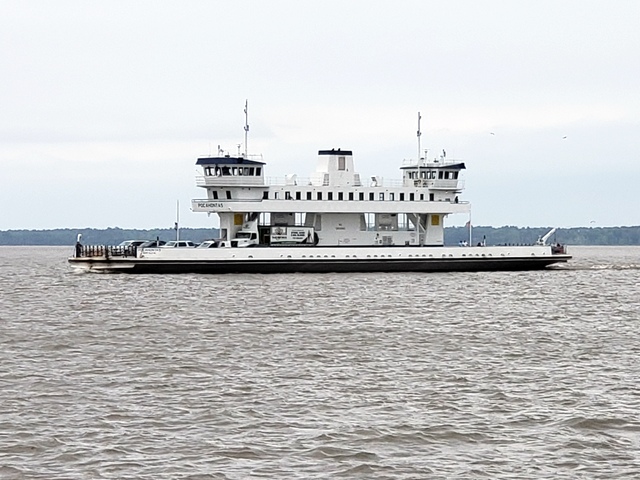
THE FERRY WE TOOK TO CROSS THE JAMES RIVER
THE ALGONQUIN VILLAGE
THE SUSAN CONSTANT, THE GODSPEED AND THE DISCOVERY
There is so much neat historical significance in and around this area that I just do not know where to being. First, we have Jamestown, the first permanent English community that was founded in the US, way back in 1607, 13 years before the Pilgrims landed on Plymouth Rock up in Massachusetts. Then we have the Chippokes Plantation, whose land we are camping on, which is the oldest, continuously farmed land in the US, specifically for 399 years! We have Yorktown close by, where Cornwallis surrendered to the combined America and French forces which led to the end of the Revolutionary War and the birth of our nation. We also have Colonial Williamsburg near us. Colonial Williamsburg has a living history museum where three streets of the original Williamsburg have been preserved with houses and shops dating back to the Colonial period of the US. Finally, we have the most interesting story of the ship Sea Venture that sunk in July 1609 during a storm after striking a reef on the eastern shore of Bermuda. It is significant to this area because it was part of the second group of supply ships that were headed for Jamestown. The survivors of that wreck ended up building two ships from the wreckage and in 1610, arrived in Jamestown with their harrowing tale.
I am not sure I will have a chance to adequately discuss all of this history in the short time we are here but I will give it a yeoman’s effort. Today, I will discuss the Chippokes Plantations since we are camping on its grounds and Mary Margaret and I went this afternoon to explore it.
As it turns out, the Chippokes Plantation is the oldest continuously farmed plantation in the US and has retained its original boundaries since it was established in 1619. This was a year before the Pilgrims, sailing on the Mayflower, landed in Plymouth, Massachusetts.
It was established by Captain William Powell. He was Lieutenant Governor of Jamestown at that time. The records are not clear if William Power landed with the first fleet of ships that were sent from England in 1607 (the Susan Constant, Godspeed and Discovery) and founded Jamestown or arrived with the second group of supply ships in 1609. However, it is clear that he did establish Chippokes Plantation, which is located right across the river from Jamestown. In 1619 Powell established the plantation and named it after the local Algonquian Indian Chief Choapoke, who he killed in a 1610 raid in retaliation of an attack that Chief Choapoke led on Jamestown a few days before. Chief Choapoke had his village on the land that became the plantation.
Powell was later killed in early 1623 in an Indian ambush and the plantation was passed on to his son, George. George soon sold it and it has changed hands frequently through time. Unlike many large plantations along the James River, it was never a family seat during the 1600 and 1700s, but, served as a secondary plantation managed by overseers or farmed by tenants.
Today, the plantation has a number of historic buildings, the earliest dates back to early 1800s. The first house we visited is called the River House. Built in two phases starting 1830s and then expanded during the 1840s. The house was gutted in a restoration attempt in the mid-1900s but never completed. Here are the pictures I took.
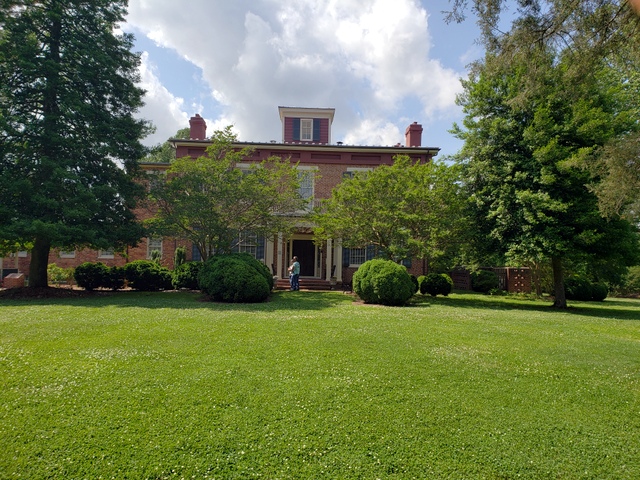
Next, we went to the Jones-Stewart Mansion that was built in the 1850s. It was fully furnished with period antiques but we were not allowed to take pictures inside. I have posted the picture we took from the outside.
We also visited the kitchen outbuilding. The docent was dressed in period dress and gave us a personal description of cooking activities that occurred here. It was wonderful.
Tomorrow, we hope to explore Jamestown, weather permitting.
Yesterday, it poured, poured and poured some more. While where we had set up LeuC was relatively dry, just a few feet away, where our fire ring and picnic table were located, was under water. We had received Flash Flood warnings for the next two days and the warnings were accurate. Needless to say, we spend yesterday hunkered down, nice and dry within the very comfortable ambiance that LeuC provides.
This morning, between rain bursts, we bundled up LeuC, made a quick drive over to the dump station to discharge our accumulations of our grey and black water tanks. We also hooked up our little Fiat to LeuC and made an escape down the road. We regretted leaving the Falls Lake’s Rolling View Campground without having much of a chance to explore it and its surrounding areas. However, the rain was just too much of a wet blanket to get out and explore.
Our goal today was to continue our drive north with our destination the Chippokes Plantation State Park, located right across the James River from Jamestown, Virginia. It rained during the entire 3.5 hours of our drive. Most of the time, the rain was just a drizzle, but it kept our speed down some, especially on the miles of country back roads we had to take to get to our campground. These backroads did not have any shoulders, had overhanging branches, and tons of sharp curves. Our RV’s GPS kept on “dinging”, announcing warnings of “sharp curves ahead”. Even though the speed limit ranged from 45 to 55 MPH, I had to keep LeuC’s speed down to the 35 to 50 MPH range to keep her on the wet roads.
When we arrived, we discovered that our campground is very “sweet” and is nestled within another deciduous and pine forest. If this state park is any indication of what the rest of the state parks of Virginia are like, they are doing an awesome job! We have a very large pull-though site with 50 Amps of power, water, a large gravel area next to us which houses a nice picnic table and a fire ring. Sweet!
We are located on a former plantation which is in the heart of the Jamestown, Yorktown and Williamsburg historical areas. Even with rain being forecast during our stay here, we are definitely going to spend some serious time touring these areas!


 Jamie will be going out to Palo Alto, California in a couple of weeks to tour Stanford University, one of the schools he is looking into attending. He is just finishing up his Junior year in high school and is well into the evaluation process, searching out where he wants to go to continue his education. He will be joined with the rest of his family as they will all be driving from the San Francisco Bay area up to Sun Valley, Idaho for a vacation. While in the San Francisco Bay area, they will have breakfast with our daughter Heather and our son, David Paul, and their respective families. Whoo Hoo!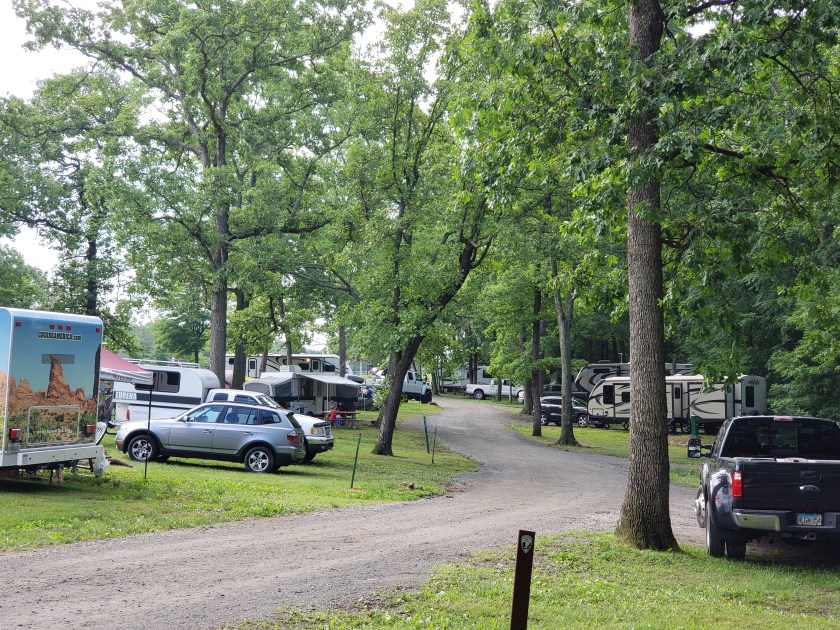








 Going Down The Road With The Leu's